Buffon’s needle problem
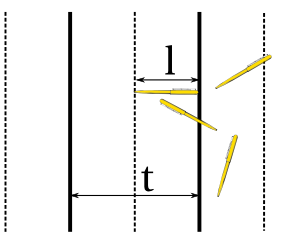 A classic example of the Monte Carlo (MC) method is throwing a ballpoint pen onto a tiled floor. We want to find the probability that the pen comes to rest across a grout line when thrown on the floor. The problem is somewhat harder than computing the ratio between the areas of a circle and a square, since the boundary conditions are not as obvious. To start, let us simplify the problem and assume we are only interested in crossing the longitudinal lines, which are spaced a distance t apart. We are interested in the specific case where the length of the pen is half the width between grout lines (l = t/2). The probability that it lands on a grout line is obviously less than 1. So how much is it? Let us do a numerical throwing experiment where in the end we are interested in the ratio between all throws (N) and the number of times a grout line was crossed. What is this ratio?
Instructions:
Use a uniform random number generator such as drand48() and its variants to create a serial program. When writing the serial program, focus on correctness rather than speed, and do not optimise the code to the point of incomprehensibility. If you wish, you can choose units for l/t that are most intuitive to you.
Since in practice we cannot check what the final ratio is, use long integers for counting. We suggest N=300000000
Measure the time of the serial program on one processor of any node with the command
srun --partition=rome --ntasks=1 ./buffonExtend the program with OpenMP directives and use the thread-safe function drand48_r()
Compile and run on a node with different numbers of threads (from 1 to 24) using the commands
gcc -O2 -fopenmp -o buffonmp buffonmp.c -lm
time srun --partition=rome --ntasks=1 --cpus-per-task=24 --export=ALL,OMP_NUM_THREADS=24 ./buffonmp
Use a reduction to combine the individual hit counts
Adapt the same program for MPI, which you run on multiple processors in the classic way
sbatch --ntasks=24 --output=buffonmpi.log --wrap="mpirun buffonmpi" # or with
time srun --partition=rome --ntasks=4 ./buffonmpi # for manual timing
Make a table of wall-clock times.
Try a hybrid OpenMPI/MP program, compiled with
mpicc -fopenmp -o buffonhy buffonhy.c -lm
sbatch --ntasks=24 --ntasks-per-node=12 --output=buffonhy.log --wrap="mpirun buffonhy"
How many throws / how much of our time do we need to get a slightly better result?
Once you have done all this, your boss told you that he is not interested in the simplified case but in the one that also has horizontal grout lines.
Serial program
#include
#include
#include
#define N 300000000
#define t 1.0
#define l 0.5

int main(int argc, char *argv[])
{
  long i, count = 0;
  double x, phi;
  for(i = 0; i < N; ++i)
    {
      x = t*drand48() - t/2;
      phi = 2*M_PI*drand48();
      double x1 = x-l/2*cos(phi);
      double x2 = x+l/2*cos(phi);
      if (x1 < 0 && x2 > 0 || x1 > 0 && x2 < 0)
        ++count;
    }
  printf("Razmerje = %lf\n", (double)N/count);
}
OpenMP
Because of shared memory, with OpenMP care must be taken to use library routines that are thread safe, as they must not contain static state variables.
#include
#include
#include
#include

#define N 300000000
#define t 1.0
#define l 0.5

int main(int argc, char *argv[])
{
  long i, count = 0;
  struct drand48_data buffer;

#pragma omp parallel private(buffer)
  {
    double x, phi;
    srand48_r(omp_get_thread_num(), &buffer);
#pragma omp for private (x, phi) reduction(+:count)
    for(i = 0; i < N; ++i)
      {
        drand48_r(&buffer, &x);
        x -= 0.5;
        drand48_r(&buffer, &phi);
        phi *= 2*M_PI;
        double x1 = x-l/2*cos(phi);
        double x2 = x+l/2*cos(phi);
        if (x1 < 0 && x2 > 0 || x1 > 0 && x2 < 0)
          ++count;
      }
  }
  printf("Razmerje = %f\n", (float)N/count);
}
MPI
#include
#include
#include
#include

#define N 300000000
#define t 1.0
#define l 0.5

int main(int argc, char *argv[])
{
  long i, count = 0;
  struct drand48_data buffer;
  int id, procesov;

  MPI_Init(&argc, &argv);
  MPI_Comm_rank(MPI_COMM_WORLD, &id);
  MPI_Comm_size(MPI_COMM_WORLD, &procesov);

  double x, phi;
  srand48_r(id, &buffer);
  for(i = id; i < N; i += procesov)
    {
      drand48_r(&buffer, &x);
      x -= 0.5;
      drand48_r(&buffer, &phi);
      phi *= 2*M_PI;
      double x1 = x-l/2*cos(phi);
      double x2 = x+l/2*cos(phi);
      if (x1 < 0 && x2 > 0 || x1 > 0 && x2 < 0)
        ++count;
    }
  long total=0;
  MPI_Reduce(&count, &total, 1, MPI_LONG, MPI_SUM, 0, MPI_COMM_WORLD);
  if (id == 0)
    printf("Razmerje = %f\n", (float)N/total);
  MPI_Finalize();
}
Buffonovo vprašanje
Klasičen primer Monte Carlo (MC) metode je metanje kemičnega svinčnika na tla s ploščicami. Želimo ugotoviti kolikšna je verjetnost, da se kemik ustavi na fugi ko ga vržemo na tla. Problem je nekoliko zahtevnejši od računanja razmerja med površino kroga in kvadrata, saj robni pogoji niso tako očitni. Za začetek poenostavimo problem in predpostavimo, da nas zanima samo prekrivanje vzdolžnih črt, ki so z razmaknjene za razdaljo t. Zanima nas konkreten primer ko je dolžina kemika polovico širine med fugami (l = t/2). Verjetnost je, da pade na fugo je očitno manjša kot 1. Koliko torej je? Naredimo numerični eksperiment z mentanjem tako da nas na koncu zanima razmerje med vsemi vrženimi (N) in številom, ko je bila fuga prekrita. Kolikšno je to razmerje.
Napotki:
Uporabite uniformni generator nakljčnih števil kot je npr drand48() in njegove variante za izdelavo serijskega programa. Pri izdelavi serijskega programa se osredotočite na pravilnost delovanja in ne na hitrost in s tem optimiranje kode do nerazumljivosti. Če želite si lahko za l/t izberete enote, ki so vam najbolj razumljive.
Ker v praksi ne moremo preveriti kakšno je končno razmerje uporabite dolga števila za štetje. Predlagamo N=300000000
Izmerite čas serijskega programa na enem procesorju poljubnega vozlišča z ukazom
srun --partition=rome --ntasks=1 ./buffonProgram razširite z OpenMP ukazi ter uporabo nitno varne funkcije drand48_r()
Na vozlišču prevedite in poženite z različnim številom niti (od 1 do 24) z ukazi
gcc -O2 -fopenmp -o buffonmp buffonmp.c -lm
time srun --partition=rome --ntasks=1 --cpus-per-task=24 --export=ALL,OMP_NUM_THREADS=24 ./buffonmp
Za sestavljanje posameznih seštevkov zadetkov uporabite redukcijo
Predelajte taisti program še za MPI, ki ga poganjate na več procesorjih s klasičnim načinom
sbatch --ntasks=24 --output=buffonmpi.log --wrap="mpirun buffonmpi" # ali z
time srun --partition=rome --ntasks=4 ./buffonmpi # za ročno merjenje časa
Naredite si tabelo s stenčasi.
Poskusite s hibridnim programom OpenMPI/MP, kjer prevajamo z
mpicc -fopenmp -o buffonhy buffonhy.c -lm
sbatch --ntasks=24 --ntasks-per-node=12 --output=buffonhy.log --wrap="mpirun buffonhy"
Koliko metov/ našega časa rabimo da dobimo še malo boljši rezultat?
Ko ste vse to naredili, Vam je šef rekel, da ga ne zanima poenostavljen primer ampak tisti, ki ima še horizontalne fuge.
Serijski program
#include
#include
#include
#define N 300000000
#define t 1.0
#define l 0.5

int main(int argc, char *argv[])
{
  long i, count = 0;
  double x, phi;
  for(i = 0; i < N; ++i)
    {
      x = t*drand48() - t/2;
      phi = 2*M_PI*drand48();
      double x1 = x-l/2*cos(phi);
      double x2 = x+l/2*cos(phi);
      if (x1 < 0 && x2 > 0 || x1 > 0 && x2 < 0)
        ++count;
    }
  printf("Razmerje = %lf\n", (double)N/count);
}
OpenMP
Zaradi deljenega spomina je pri OpenMP potrebno paziti, da se uporabljajo rutine iz knjižnic, ki so thread safe saj ne smejo vsebovati statični spremeljivk stanja.
#include
#include
#include
#include

#define N 300000000
#define t 1.0
#define l 0.5

int main(int argc, char *argv[])
{
  long i, count = 0;
  struct drand48_data buffer;

#pragma omp parallel private(buffer)
  {
    double x, phi;
    srand48_r(omp_get_thread_num(), &buffer);
#pragma omp for private (x, phi) reduction(+:count)
    for(i = 0; i < N; ++i)
      {
        drand48_r(&buffer, &x);
        x -= 0.5;
        drand48_r(&buffer, &phi);
        phi *= 2*M_PI;
        double x1 = x-l/2*cos(phi);
        double x2 = x+l/2*cos(phi);
        if (x1 < 0 && x2 > 0 || x1 > 0 && x2 < 0)
          ++count;
      }
  }
  printf("Razmerje = %f\n", (float)N/count);
}
MPI
#include
#include
#include
#include

#define N 300000000
#define t 1.0
#define l 0.5

int main(int argc, char *argv[])
{
  long i, count = 0;
  struct drand48_data buffer;
  int id, procesov;

  MPI_Init(&argc, &argv);
  MPI_Comm_rank(MPI_COMM_WORLD, &id);
  MPI_Comm_size(MPI_COMM_WORLD, &procesov);

  double x, phi;
  srand48_r(id, &buffer);
  for(i = id; i < N; i += procesov)
    {
      drand48_r(&buffer, &x);
      x -= 0.5;
      drand48_r(&buffer, &phi);
      phi *= 2*M_PI;
      double x1 = x-l/2*cos(phi);
      double x2 = x+l/2*cos(phi);
      if (x1 < 0 && x2 > 0 || x1 > 0 && x2 < 0)
        ++count;
    }
  long total=0;
  MPI_Reduce(&count, &total, 1, MPI_LONG, MPI_SUM, 0, MPI_COMM_WORLD);
  if (id == 0)
    printf("Razmerje = %f\n", (float)N/total);
  MPI_Finalize();
}