HPCFS
HPCFS wiki
Basic guides
Access to HPCFS
Granting access
Ways of access
Support
Password hash generator
Support
Description of HPCFS
Hardware
Software
SLURM at HPCFS
Partition
rome
Partition
haswell
Interactive X11 jobs
Useful SLURM job information commands
Runing R script with Rmpi under SLURM
Spack at HPCFS
User Spack development
hwloc
PMIX
SLURM
OpenMPI
Linpack
OpenFOAM
TAU profiler and analysis utility
AMDScalaPack, MUMPS, PETSc
stream benchmark
ParaView/tajjatz
Fenics
gmsh@4.8.4/p2z7wue
ANSYS at HPCFS
ANSYS Fluent and SSH
ANSYS Fluent 20.1 with checkpointing and resubmit
ANSYS 21.1 on rome partition
FLUENT 2021R2 with OpenMPI or Intel MPI
ANSYS System Coupling 2021R2
Wolfram and Mathematica
License server flex.hpc
Module
Wolfram
Parallel execution on a compute node(s) [version 14.2]
News
2024 09 01
2024 03 06
2023 07 07
2023 03 01
2022 09 09
2022 07 27
2022 06 04
2022 04 11
2022 04 07
2022 04 05
2022 04 02
Parallel programming
Introduction to parallel programming
Intro to parallel programming
OpenMP overview
MPI overview
Accelerators overview
Exercise
Introduction to parallel programming
Intro to parallel programming
OpenMP overview
MPI overview
OpenMP
Getting started with OpenMP
Message Passing Interface (MPI)
3.1 Welcome to Week 3
3.2 Communicator in MPI
3.3 Hello World 2.0
3.4 Messages and communications
3.5 Quiz on MPI basics
3.6 Different types of communication in MPI
3.7 Send and receive
3.8 Ping pong
3.9 What happens with a different number of pings and pongs?
3.10 Rotating information around a ring
3.11 Dynamic Receiving with MPI PROBE and MPI STATUS
MPI_Status
and
MPI_Probe
3.12 Do you understand point-to-point communication?
3.13 Basic collective communications
3.14 Broadcast
3.15 What do you observe with broadcast communication?
3.16 Scatter and gather
3.17 Scatter and Gather
3.18 MPI_Reduce
3.19 Computing average with MPI_Reduce
3.20 Calculate Pi!
3.21 MPI_Allreduce
3.22 Computing standard deviation
3.23 Do you understand collective communication?
3.24 Test on MPI
3.25 Week 3 wrap-up
MPI Continued
4.1 Welcome to Week 4
4.2 Non-Blocking communications
Non-blocking send and receive
4.3 Rotating information around a ring (non-blocking)
4.4 One-sided communication
4.5 One-sided communication in a ring
4.6 Do you understand advanced communication in MPI?
4.7 MPI + threading methods
4.8 Calculate Pi! Using MPI_THREAD_FUNNELED
4.9 Hybrid MPI
4.10 Quiz on Hybrid programming with OpenMP and MPI
4.11 Derived data type
4.12 Derived data type
4.13 Layout of struct data types
4.14 Computing displacements
4.15 Which is the fastest neighbor communication with strided data?
4.16 Quiz on derived data types
4.17 Pass-around-the-ring exercise
4.18 Brief explanation of size, extent and alignment rules
4.19 Parallel file I/O
4.20 Four processes write a file in parallel
4.21 Week 4 wrap-up
Beyond OpenMP and MPI: GPU parallelisation
5.1 Welcome to Week 5
5.2 GPU Architecture
5.3 GPUs by numbers
5.4 Information and compute capabilities of a GPU
5.5 GPU basics and architecture
5.6 GPU execution models and programming solutions
5.7 Hello world on GPU
5.8 Hello world extended on GPU
5.9 CUDA and OpenCL execution model
5.10 Vector addition on GPU
5.11 CUDA step-by-step
5.12 OpenCL step-by-step
5.13 CUDA and OpenCL comparison
5.14 CUDA and OpenCL programming and execution models
5.15 Numerical integration: Riemann sum with trapeziums
5.16 Riemann sum with OpenMP
5.17 OpenMP off-loading to GPU for Riemann sum
5.18 Riemann sum with one GPU kernel
5.19 Profiling of the Riemann sum codes with one GPU kernel
5.20 Sum reduction
5.21 Riemann sum with parallel reduction on GPU
5.22 Profiling of the Riemann sum codes with two GPU kernels
5.23 Visual profiling and tracing of the GPU codes
Profiling and tracing of CUDA codes
Profiling and tracing of OpenCL codes
5.24 Test on GPU parallelisation
5.25 Week 5 wrap-up
5.26 Extra content: GPU programming in Python
A Short Introduction to Parallel Programming
Cluster Overview
HPCFS Hardware
A Short Introduction to Parallel Programming
High Performance Linpack
Ervin Prelog
Using the cluster
Program Development
Fortran
Fortran Basics
Fortran 90 examples
Arrays in Fortran
Input/Output in Fortran
Python basics
GPU programming with CUDA
MPI4Py
Running MPI4Py Programs
NumPy in MPI4Py
Parallel Computation of Pi (π)
Ping Pong
NumPy
ndarray
Primeri uporabe NumPy
Manipulacija z obliko ndarray
Indeksiranje polja
Napredno indeksiranje
Globalne operacije z indeksi
Univerzalne funkcije
Naprednejše funkcije: Integracija, odvajanje in linearna algebra
Povzetek
Environment Modules
Resource Manager - SLURM
VisIt
IOzone
OpenFOAM
Example: Lid-driven cavity
damBreak tutorial
sonicFoam tutorial
OpenFOAM extend
Binary installation into the home directory
Test incompressible/icoFoam/cavity
Test compressible/rhoPimpleFoam/angledDuct
Inkscape
LaTeX and SVG Images
Debugging, Analysis and Profiling of Programs
ANSYS
Ansoft
CFX software package
ANSYS Fluent Software Package
LS-DYNA
ANSYS Multiphysics
Remote Solve Manager (RSM)
Developing programs in the Eclipse environment
Elmer
Temperature Field of a Solid Body
Loaded elastic cantilever
Heat Flow in a Curved Pipe
Vortex Development - von Karman Instability
Magnetic Field of a Winding
Message Passing Interface (MPI)
Wolfram Mathematica
Whiteboard collaboration with NX shadow client
Shared-Memory Programming with OpenMP
Platform Managment Console
R
Obsolete
Cluster Management Utility
Distributed Debugging Tool
Invention Machine Goldfire Innovator
Subversion
Unigraphics NX
Mail
TotalView
Mellanox® Unified Fabric Manager software
Projects and Events
Partnership for Advanced Computing in Europe (PRACE)
European eXtreme Data and Computing Initiative
European HPC Summit Week 2018
International HPC Summer School 2016
HPC Campus School 2014
Buffon’s needle problem
Game of Life
Parallel Image Processing
PRACE Autumn School 2013 - Industrial Simulations on Supercomputers
PRACE Autumn school 2018
PRACE Autumn school 2020
PRACE Summer of HPC 2014
Get to Know European Supercomputers – PRACE Summer of HPC 2015
PRACE Summer of HPC 2016
PRACE Summer of HPC 2017
PRACE Summer of HPC 2018
PRACE Summer of HPC 2019
PRACE Summer of HPC 2019 opens applications
About the PRACE Summer of HPC Programme
Participating in the PRACE Summer of HPC Programme
Project Descriptions
More Information
Applications
Follow Us
PRACE Summer of HPC 2020
PRACE Campus School 2012
Introduction to Linux
Demonstration of Using Programs on HPCFS
Introduction to Python
Python OpenMPI
On a Creative Path - A Supercomputer for Everyone
HPC Summer Workshop 2021
HPC Summer Workshop 2014 for Secondary School Students
HPC Summer Workshop 2015
HPC Summer Workshop 2016
HPC Summer Workshop 2017
HPC Summer Workshop 2018
HPC Summer Workshop 2019
HPC Summer Workshop 2020
Call for access to PRACE Tier-0 supercomputers
Call for Proposals for ARRS 2012 Computationally Intensive Simulation Projects
Call for Proposals for Computationally Intensive Simulation Projects
Call for Proposals for Computationally Intensive Engineering Simulation Projects Using ANSYS Software
Projekta EUFORIA in EFDA-ITM-ISIP
Summer of HPC 2013 for Students
Numerical Simulation of the Turbolent Flow around the Sphere
Free-Surface Geometry Optimisation
Extension of Collisionless Discharge Models for Application in Fusion-Relevant and General Plasmas
Velocity profile effects in coriolis mass flowmeters
Numerical Simulations in Road and Off-Road Vehicle Safety
CDF modeling of breathing process influence on personal exposure effectiveness
Rotating cascade heat transfer using CFD and IR thermography
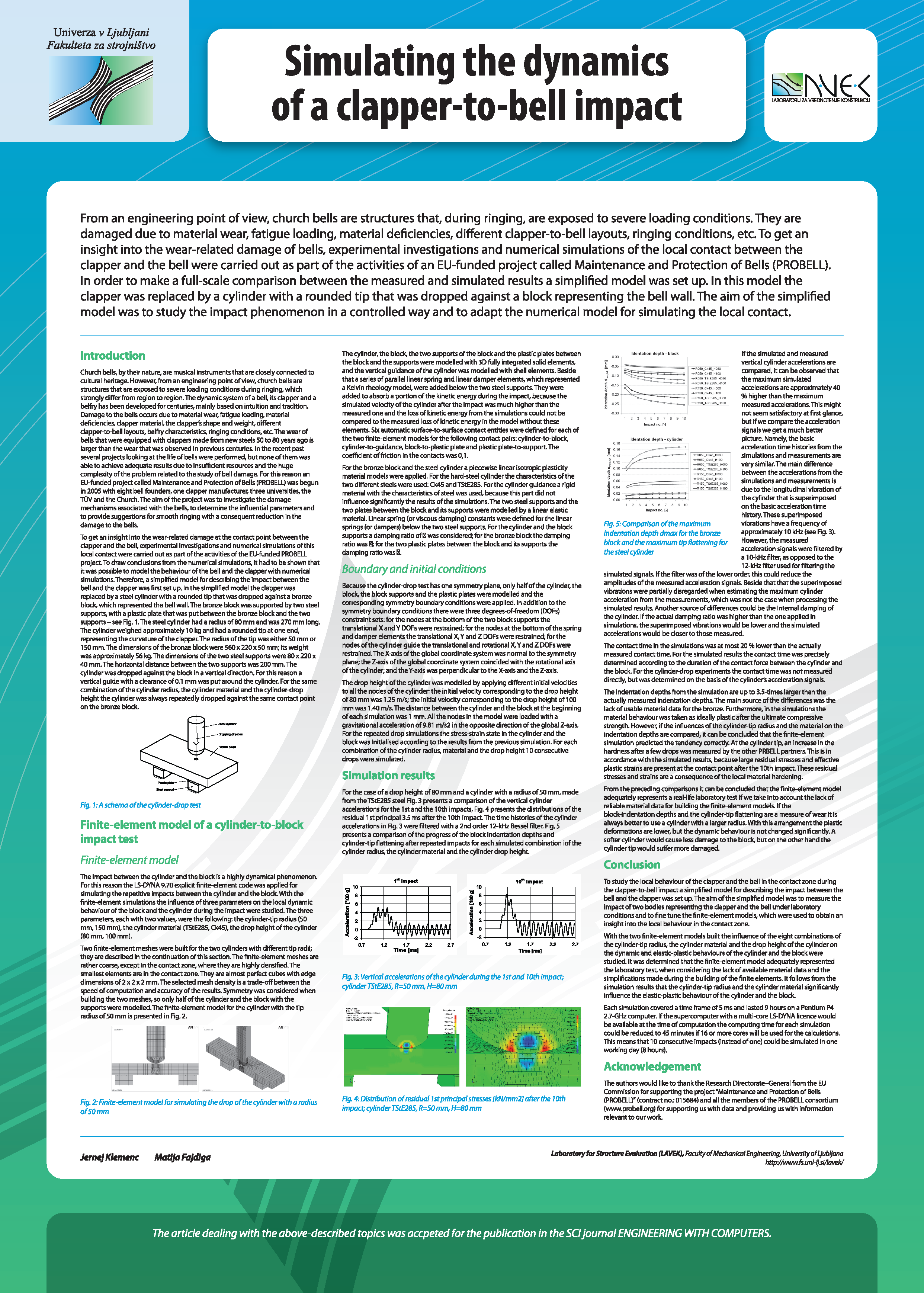
Simulating the dynamics of clapper-to-bell impact
Strategic Research and Development Project
Parallel computing with load balancing
Laser droplet generation datachment regimes
HPCFS
Projects and Events
Simulating the dynamics of clapper-to-bell impact
View page source
Simulating the dynamics of clapper-to-bell impact