HPC Campus School 2014
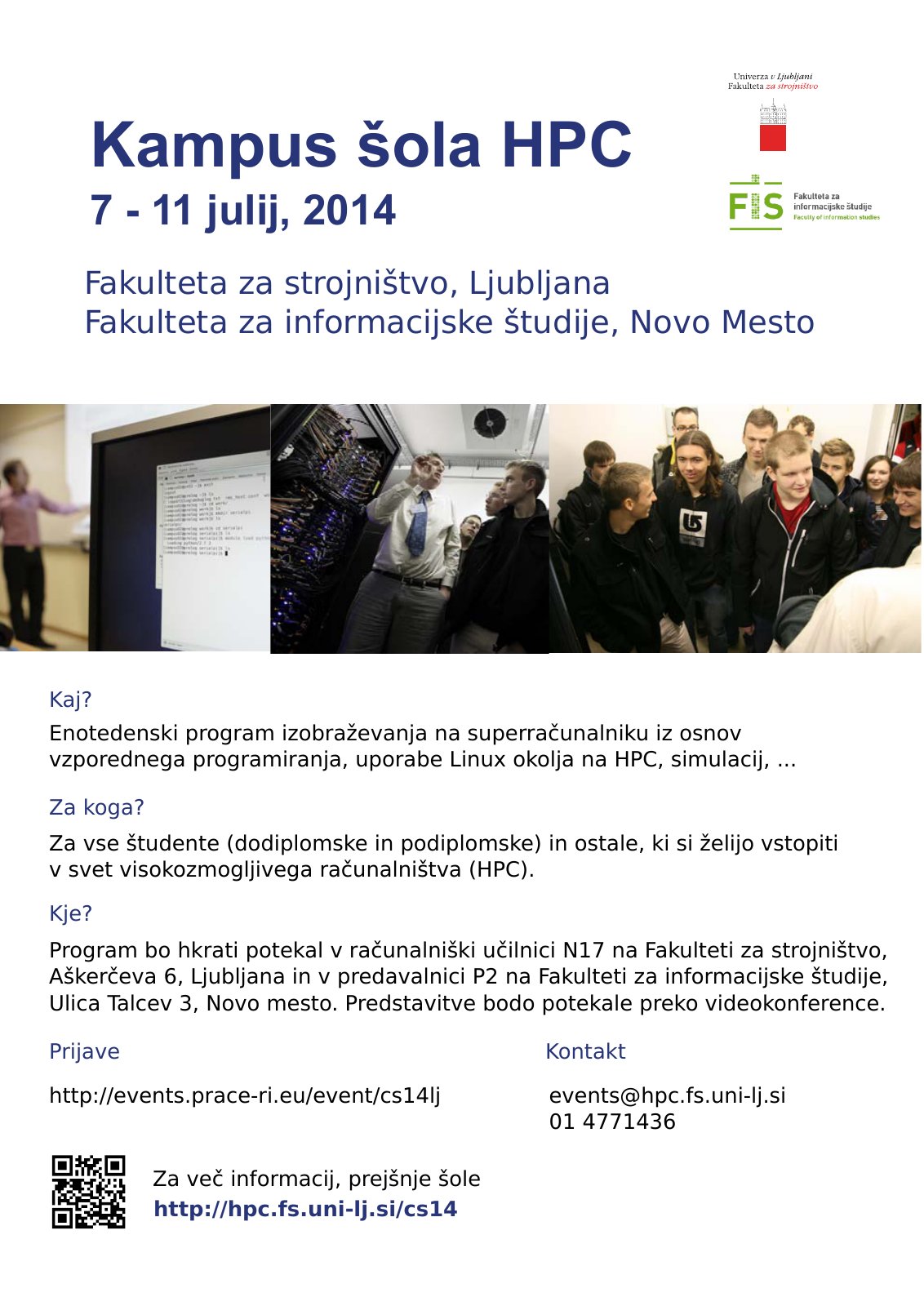
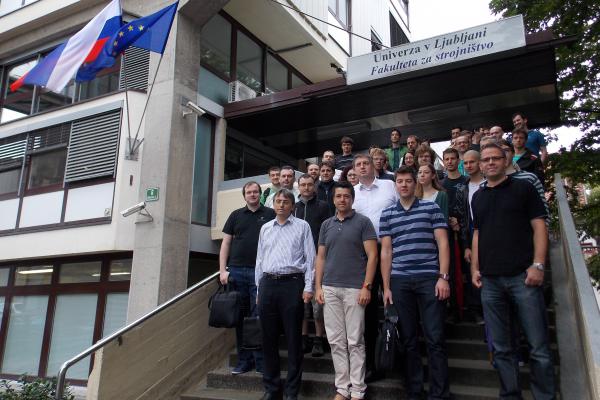 High Performance Computing (HPC) Campus School at the start of the summer holidays (7–11 July 2014)
For all students (undergraduate and postgraduate) at UL, FIŠ and others who want to enter the world of supercomputing, discover various programming languages and simulation programs, and learn the basics of running parallel programs. Students are recommended to have at least some programming knowledge. The registration fee of €10 includes lectures and refreshments during breaks. The registration fee for employees from outside the university who do not have student status is €150. Registration and details on the website: http://events.prace-ri.eu/event/cs14lj
Materials from the exercises and lectures are available in the HPC school timetable.
The programme will run simultaneously at two locations: at the Faculty of Mechanical Engineering in Ljubljana, Aškerčeva 6, and at the Faculty of Information Studies, Novo Mesto, Ulica talcev 3. Exercises on the HPCFS supercomputer will be run from both locations, only the “instructors” will be different. We will also invite various experts who will, in person or via videoconference, show further interesting applications, such as special coprocessor architectures (GPU), simulations, and also theory from various fields that are interesting and require parallelisation.
The HPC Campus School primarily aims to show students the possibilities and ease of use of supercomputers and to present concrete examples through exercises on the supercomputer itself. Through the exercises and by repeating the examples you will learn to use the Linux environment, on which HPC mostly runs. Using examples, we will also look at programming languages that allow a problem to be distributed across multiple processors. Usually this is C or Fortran. But Python is also a language in which the divide and conquer principle can be tried out without compilation. At each exercise we will explain the programming language and its extensions for parallel computing in detail.
Classically, C and Fortran compilers offer two ways of achieving faster computation through distribution. In the simpler approach, OpenMP directives written in program comments describe how a particular part of the code should be parallelised. With OpenMP we can therefore start parallelising once the serial program already works reliably but we have run into slow performance. With OpenMP the program can be compiled once serially and once in parallel, making it easy to check whether the parallelisation is correct. The compiler itself takes care of parallelisation by creating threads, and the operating system kernel ensures that they run on separate cores. OpenMP comments in programs make sure that the shared memory used by all threads is properly synchronised and that no problems arise from simultaneous write access to shared variables. The drawback of OpenMP is that threads can only be created on a single node, which in practice has 2–32 cores available for parallelisation. The OpenMP approach is therefore suitable even for very small “machines” such as our laptops or even mobile devices, and that is precisely the advantage of OpenMP: anyone can try parallel programming without needing expensive hardware.
For larger parallelisation demands, or when we can see from the start that the problem will be demanding, we write it in MPI (Message Passing Interface), which is in fact a library for sending data from one process to another. The processes can be on different computers, which means there are no major limits on the number of processes that cooperate in solving the problem. There are also several programming languages for MPI. As already mentioned, besides the classics we will also look at Python and the MPI4Py library, with examples through which we will learn the language and experiment with parallelism at the same time.
The purpose of HPC is usually to save time in solving a particular problem, and HPC tools can help substantially with that. Provided we know how to use them, of course. The HPC Campus School will show us how in a “fun” way. Participants will also receive certificates of attendance.
Welcome!
Time |
Monday 7 July |
Tuesday 8 July |
Wednesday 9 July |
Thursday 10 July |
Friday 11 July |
Morning 9:00-12:30 |
Introduction to Linux |
Lectures and HPC theory |
HPC in practice (NM) and simulations (FS) |
Introduction to Python and MPI4Py at FS (organised transport from NM to LJ and back) |
Parallel algorithms and visualisation |
Break 13:00 - 14:30 |
Lunch |
Lunch |
Lunch |
Lunch |
Lunch |
Afternoon 14:30 - ~17h |
Linux HPC environment |
HPC exercises |
Hands-on testing of the morning lectures |
Python and MPI4Py exercises (hands-on work in the morning as well) |
Hands-on exercises on the morning topics |
Outline programme of the HPC Campus School 2014
Detailed overview (green - FIŠ exercises, light blue - FS exercises)
Time
Monday
Tuesday
Wednesday
Thursday
Friday
9:00 - 9:30
Welcome at FS,
Presentation of the summer school,
HPC tour,
Introduction to GNU/Linux, GUI environments
Introduction to HPC (video link to LJ),
Basic C statements,
Presentation of MPI on HPCFS
Using GPUs (Abelium)
Python + MPI,
programming simple message-passing examples with MPI4Py,
Introduction to the design and analysis of parallel algorithms, Presentation of the HiPEAC summer school (video link to LJ)
9:30 - 10:00
10:00 - 10:30
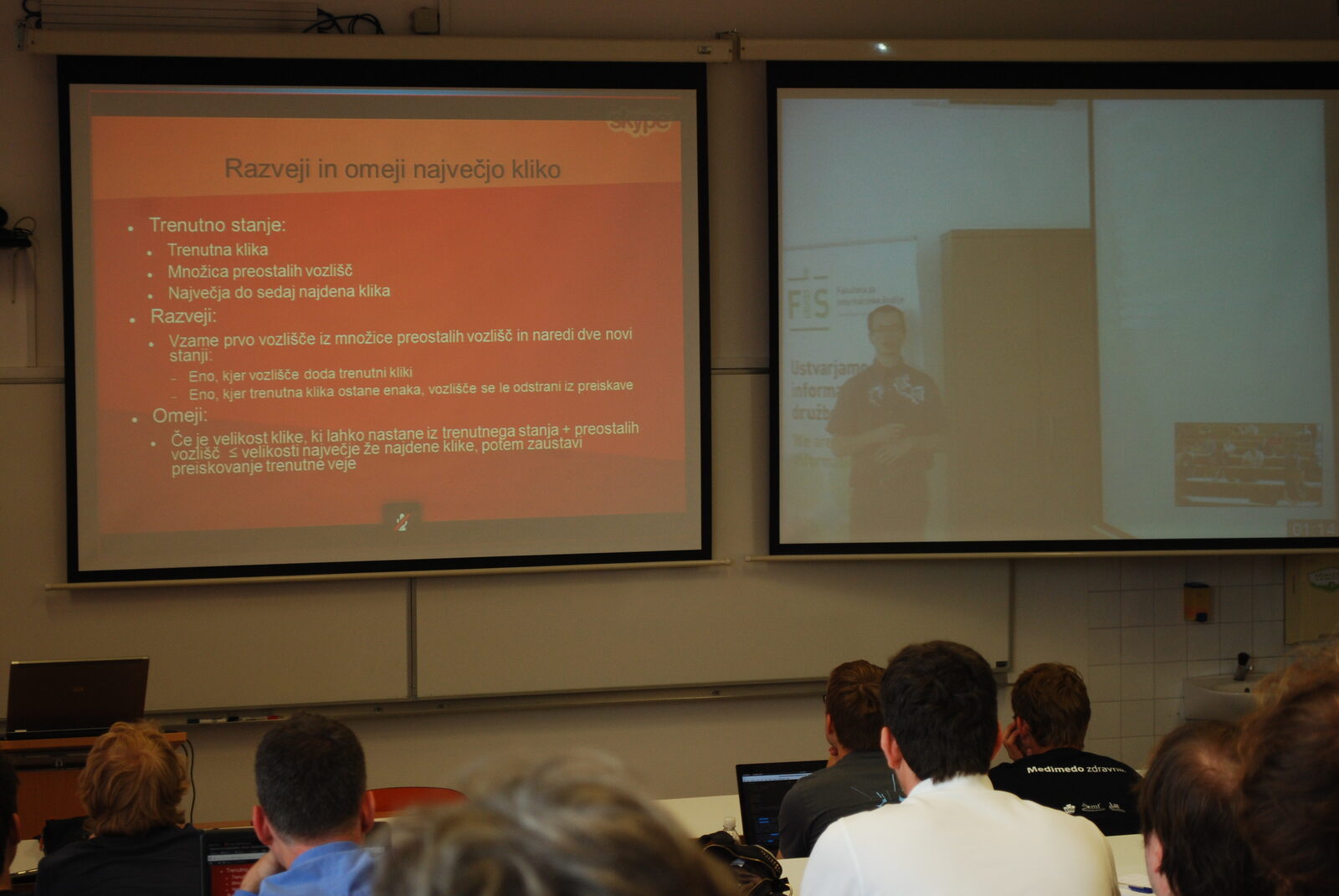
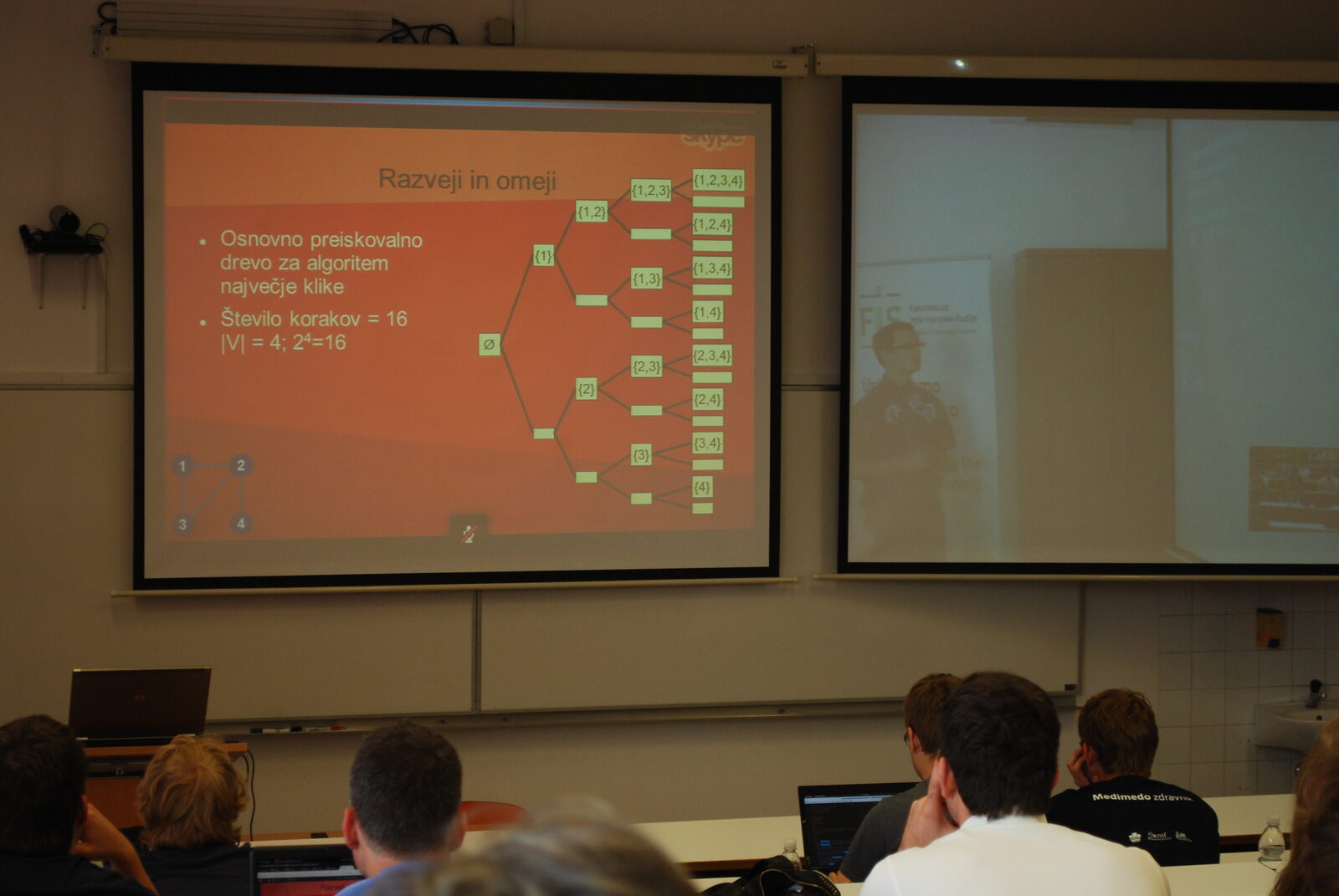
The max-clique problem (IJS)
10:30 - 11:00
11:00 - 11:30
Molecular simulations of biological macromolecules (National Institute of Chemistry)
Introduction to PGAS programming (X10, Chapel); Managing systems with HPC-PUPPET (Arctur); Visualisation on HPC ; Presentation of the PRACE organisation and access to TIER-1 and TIER-0 supercomputers (video link to NM)
11:30 -12:00
12:00 - 12:30
Presentation of open-source simulation programs (FS)
12:30 - 13:00
13:00 - 14:30
Lunch
Lunch
Lunch
Lunch
Lunch
14:30 - 15:00
Bash, AWK scripts, Introduction to programming,
Programming languages in Linux
Practical data-rearrangement problems with sed, awk and the bash shell, and SLURM,
Welcome at FIŠ, Short introduction to Linux, programming environments, HPC exercises
MPI exercises on HPCFS
HPC exercises
Simulations on HPCFS: CFD exercises (Fluent, OpenFOAM)
HPC exercises
More advanced MPI4Py examples, solving tasks in small groups
Visualisation exercises (GNUplot, Inkscape, LLNL VisIt, ParaView, Inkscape, OpenGL, WebGL, … )
Various exercises, and presentation and analysis of student assignments
15:00 - 15:30
15:30 - 16:00
16:00 - 16:30
16:30 - 17:00
Closing
Closing
17:00 - 17:30
17:30 - 18:00
Attachment |
Size |
|---|---|
301.28 KB |
|
475.12 KB |
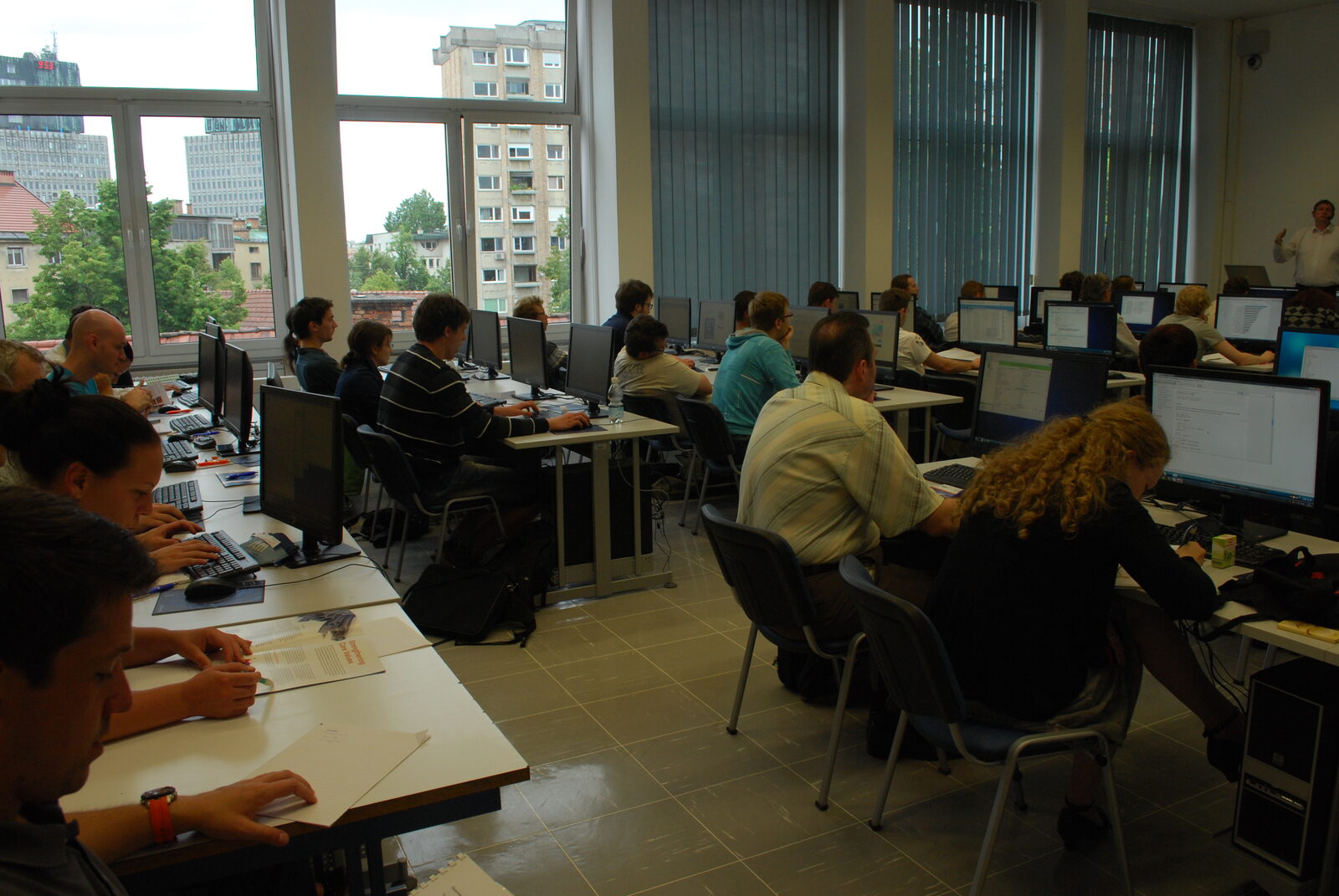
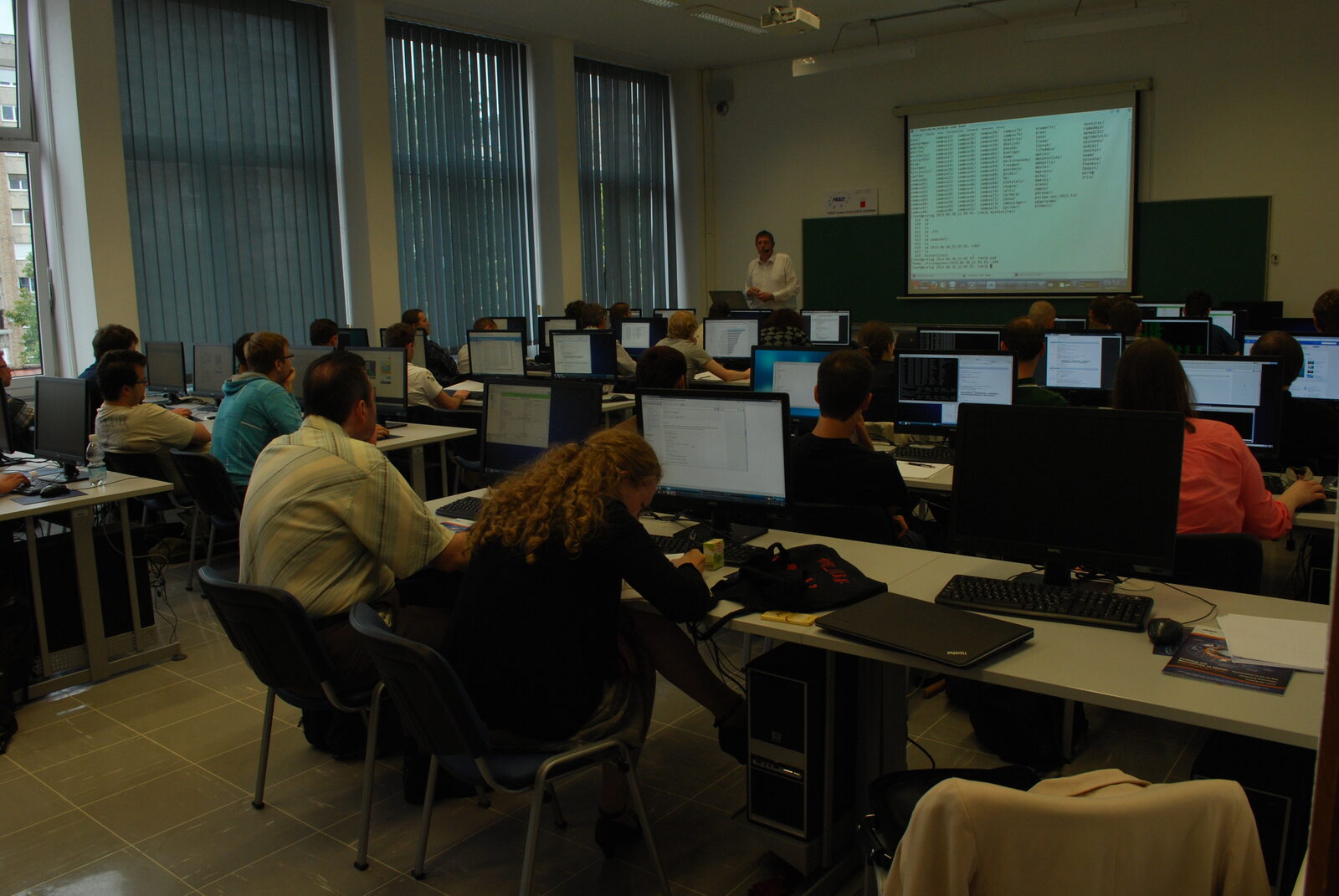
| In the FS classroom. Lecture by M. Depolli (IJS) | 3.56 MB | | Max clique | 3.48 MB | | Thursday’s demonstration of HPCFS tools (FIŠ in the back rows) | 3.9 MB | | Thursday’s demonstration of HPCFS tools | 3.67 MB |
Kampus šola HPC 2014
Kampus šola visokozmogljivega računalništva (HPC) na začetku poletnih počitnic (7.-11. julij 2014)
Za vse študente (dodiplomske in podiplomske) na UL, FIŠ in ostale, ki si želijo vstopiti v svet superračunalništva, odkriti različne programske jezike in programe za simulacije ter pridobiti osnove v poganjanju vzporednih programov. Priporočeno je, da imajo študentje vsaj nekaj znanja iz programiranja. Prijavnina 10€ vključuje predavanja ter pogostitev med odmori. Prijavnina za zaposlene izven univerze, ki nimajo status študenta, je 150€. Prijave in podrobnosti na spletni strani: http://events.prace-ri.eu/event/cs14lj
Material z vaj in predavanj je na voljo na urniku HPC šole.
Program se bo hkrati izvajal na dveh lokacijah. Na Fakulteti za strojništvo v Ljubljani, Aškerčeva 6 in na Fakulteti za informacijske študije, Novo Mesto, Ulica talcev 3. Vaje bodo na superračunalniku HPCFS potekale iz obeh lokacij, le da bodo “inštruktorji” različni. Povabili bomo tudi različne strokovnjake, ki nam bodo v živo ali preko videokonferenčnega sistema pokazali še zanimive aplikacije, kot so posebne arhitekture koprocesorjev (GPU), simulacije in pa tudi teorija s tega in onega podočja, ki je zanimivo in potrebuje paralelizacijo.
Kampus šola HPC želi predvsem približati študentom na možnosti in lahkotnost uporabe superračunalnikov in pokazati konkretne primere skozi vaje na samem superračunalniku. Skozi vaje in ponavljanju primerov se boste naučili uporabljati okolje Linux na katerem HPC večinoma teče. Na primerih si bomo pogledali tudi programske jezike, ki omogočajo porazdelitev problema na več procesorjev. Običajno je to programski jezik C ali Fortran. Pa tudi Python je jezik, s katerim se da brez prevajanja preizkušati načelo deli in vladaj. Ob vsakih vajah bomo podrobno razložili programski jezik in njegove razširitve za vzporedno računanje.
Klasično v prevajalnikih C in Fortran obstajata dva načina doseganja hitrejšega računanja s porazdelitvijo. V enostavnejšem načinu z ukazi OpenMP kar v komentarje programa popišemo kako naj se določen del kode paralelizira. Z OpenMP lahko torej pričnemo paralelizirati, ko nam serijski program že preizkušeno deluje, naleteli pa smo na počasno delovanje. V OpenMP lahko tako program enkrat prevedemo serijsko in drugič paralelno ter tako enostavno preverimo ali je paralelizacija pravilna. Za paralelizacijo skrbi prevajalnik sam tako, da kreira niti (threads), za katere samo jedro operacjskega sistema že samo poskrbi, da se izvajajo na ločenih jedrih. Komentarji OpenMP v programih pa poskrbijo, da se skupen spomin, ki ga vse niti uporabljajo, pravilno sinhronizira in da ne prihaja do težav pri hkratnem dostopu pri pisanju v skupne spremenljivke. Slabost OpenMP pa je, da se niti lahko kreirajo le na enem vozlišu, ki ima v praksi od 2 - 32 jeder na voljo za paralelizacijo. OpenMP način paralelizacije je torej primeren že za zelo majhne “strojčke”, kot so naši prenosniki ali celo prenosne naprave in prav to je tudi prednost OpenMP, da se lahko prav vsak preizkusi v vzporednem programiranju ne da bi pri tem potreboval drage strojne opreme.
Pri večjih zahtevah za paralelizacijo ali takrat ko že v začetku vidimo, da bo problem zahteven ga pišemo v MPI (Message passing Interface), ki je prav zaprav knjižnica za pošiljanje podatkov iz enega procesa v drugi. Procesi pa so lahko na različnih računalnikih, kar pomeni, da ni večjih omejitev glede števila procesov, ki sodelujejo pri reševanju problema. Tudi programskih jezikov je za MPI več. Kot že omenjeno, bomo poleg klasike pogledali tudi jezik Python in knjižnico MPI4Py ter primere s katerimi se bomo hkrati naučili jezika in še eksperimentirali paralelno.
Smisel HPC je običano prihraniti čas rešitve posameznega problema in orodje HPC nam to lahko bistveno pripomore. Če ga znamo uporabljati, seveda. Kampus šola HPC nam bo na “zabaven” načino pokazala kako. Udeležencem pa bomo izdali tudi potrdila o udeležbi.
Vabjeni!
Ura |
Ponedeljek 7.7. |
Torek 8.7. |
Sreda 9.7. |
Četrtek 10.7. |
Petek 11.7. |
Dopoldne 9:00-12:30 |
Linux uvod |
Predavanja in teorija HPC |
HPC v praksi (NM) in simulacije (FS) |
Uvod v Python in MPI4Py na FS (organiziran prevoz iz NM v LJ in nazaj) |
Paralelni algoritmi in vizualizacija |
Odmor 13:00 - 14:30 |
Kosilo |
Kosilo |
Kosilo |
Kosilo |
Kosilo |
Popoldne 14:30 - ~17h |
Linux okolje HPC |
Vaje HPC |
Praktičen preizkus dopoldanskih predavaj |
Vaje Python in MPI4Py (tudi dopoldne je praktično delo) |
Praktične vaje iz dopoldanske tematike |
Okvirni program Kampus šole HPC 2014
Podrobnejši pregled (zeleno - vaje FIŠ, svetlo modro - vaje FS)
Ura
Ponedeljek
Torek
Sreda
Četrtek
Petek
9:00 - 9:30
Sprejem na FS,
Predstavitev poletne šole,
ogled HPC,
Uvod v GNU/Linux, GUI okolja
Predstavitev HPC (video prenos v LJ),
Osnovni ukazi v C-ju,
Predstavitev MPI na HPCFS
Uporaba GPU (Abelium)
Python + MPI,
programiranje enostavnih primerov s pošiljanem sporočil z MPI4Py,
Uvod v pripravo in analizo paralelnih algoritmov, Predstavitev poletne šole HiPEAC (video prenos v LJ)
9:30 - 10:00
10:00 - 10:30
Problem max-klike (IJS)
10:30 - 11:00
11:00 - 11:30
Molekularne simulacije bioloških makromolekul (Kemijski inštitut)
Predstavitev PGAS prog. (X10, Chapel); Upravljanje sestavov s HPC-PUPPET (Arctur); Vizualizacija na HPC ; Predstavitev organizacije PRACE in dostopa do TIER-1 in TIER-0 superračunalnikov (Video prenos v NM)
11:30 -12:00
12:00 - 12:30
Predstavitev odprtokodnih simulacijskih programov (FS)
12:30 - 13:00
13:00 - 14:30
Kosilo
Kosilo
Kosilo
Kosilo
Kosilo
14:30 - 15:00
Bash, AWK skripte, Uvod v programiranje,
Programski jeziki v Linuxu
Praktični problemi preurejanja podatkov s sed, awk in lupine bash in SLURM,
Sprejem na FIŠ, Kratek uvod v Linux, programska okolja, Vaje na HPC
Vaje MPI na HPCFS
Vaje na HPC
Simulacije na HPCFS: vaje iz CFD (Fluent, OpenFOAM)
Vaje na HPC
Zahtevnejši primeri MPI4Py z reševanjem nalog v manjših skupinah
Vaje iz vizuali-zacije (GNUplot, Inkscape, LLNL VisIt, ParaView, Inkscape, OpenGL, WebGL, … )
Različne vaje ter predstavite in analiza nalog študentov
15:00 - 15:30
15:30 - 16:00
16:00 - 16:30
16:30 - 17:00
Zaključek
Zaključek
17:00 - 17:30
17:30 - 18:00
- Obvestilo na UL - ARNES - SIO - Rač. novice
Priponka |
Velikost |
|---|---|
301.28 KB |
|
475.12 KB |
| V učilnici FS. Predavanje M. Depolli (IJS) | 3.56 MB | | Max Klika | 3.48 MB | | Četrtkov prikaz HPCFS orodij (v zadnjih vrstah FIŠ) | 3.9 MB | | Četrtkov prikaz HPCFS orodij | 3.67 MB |