Parallel Image Processing
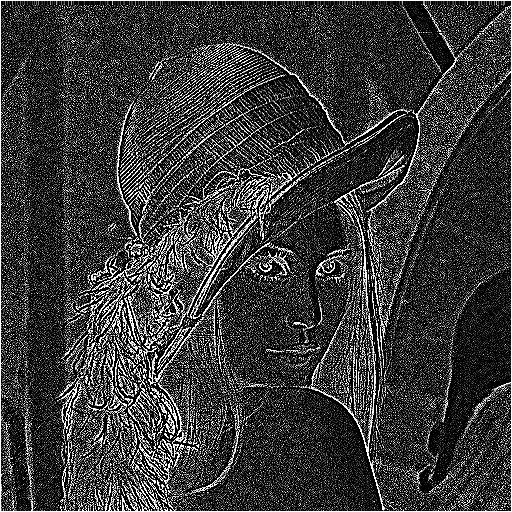 The purpose of this image processing task is to practise basic communication between parallel blocks. We will show that the original image can be reconstructed from its edges. The inverse operation is very similar to a large number of scientific problems computed on HPC that solve partial differential equations with iterative algorithms such as Jacobi or Gauss-Seidel.
Download Lena in PGM format from the web and first compute the edges, which will be somewhat darker than the side image. Use the following filter to determine the edge image

Then reconstruct the original image from that same image using the operator

using a white background (255) for old in the first iteration. Repeat the reconstruction iterations (1, 10, 100, 1000, …) and determine whether it is possible to fully reconstruct the original image.
Reading or writing binary PGM files is simple, since the ASCII header takes a couple of lines, followed by a block of character data describing the grey levels (0..255).
When parallelizing the problem, decompose it into pieces so that each processor gets a part of the image to process, which is then assembled into a whole. Try to define a stopping criterion by monitoring the largest brightness changes between the old and the new reconstructed image.
Serial code
#include
#include
#include

unsigned char *img, *out;
int width, height, *edge, *new, *old;

int read_pgm(const char *filename)
{
  char buf[80];
  FILE *f = fopen(filename, "r");
  fgets(buf, 80, f); assert(buf[0] == 'P' && buf[1] == '5');
  fgets(buf, 80, f); if (buf[0] == '#') fgets(buf, 80, f);
  sscanf(buf, "%d %d", &width, &height);
  fgets(buf, 80, f);// levels=255
  img = malloc(width*height*sizeof(char));
  fread(img, width, height, f);
  fclose(f);
  return 0;
}

void write_pgm(int *img, const char *filename)
{
  int k;
  out = malloc(width*height*sizeof(char));
  FILE *f = fopen(filename, "w");
  for (k = 0; k < width*height; ++k)
    out[k] = img[k];
  fprintf(f, "P5\n# image by HPCFS\n%d %d\n255\n", width, height);
  fwrite(out, width, height, f);
  free(out);
  fclose(f);
}

void detect_edge()
{
  int i, j;
  edge = malloc(width*height*sizeof(int));
  for (i = 0; i < height; i++)
    for (j = 0; j < width; ++j)
      {
        if (i == 0 || i == height-1 || j == 0 || j == width-1)
          edge[i*width+j] = 255;
        else
          {
            edge[i*width+j] =((int)img[(i-1)*width+j]
                              +(int)img[(i+1)*width+j]
                              + (int)img[i*width+j-1]
                              + (int)img[i*width+j+1]
                              - 4*(int)img[i*width+j]);
          }
      }
}

void reconstruction(int iters)
{
  int i, j, k;
  new = malloc(width*height*sizeof(int));
  old = malloc(width*height*sizeof(int));
  for (k = 0; k < width*height; ++k)
    old[k] = 255;

  for (k = 0; k < iters; ++k)
    {
      int *tmp;
      #pragma omp parallel for
      for (i = 0; i < height; i++)
        for (j = 0; j < width; ++j)
          {
            if (i == 0 || i == height-1 || j == 0 || j == width-1)
              new[i*width+j] = 255;
            else
              {
                int level =  (old[(i-1)*width+j]+old[(i+1)*width+j]
                              + old[i*width+j-1] + old[i*width+j+1]
                              - edge[i*width+j])/4.0;
                //if (level < 0) level = 0;  if (level > 255) level = 255;
                new[i*width+j] = level;
              }
          }
      tmp = old; old = new;  new = tmp;
    }
}

int main(int argc, char *argv)
{
  read_pgm("lena512.pgm");
  detect_edge();
  write_pgm(edge, "edge.pgm");
  reconstruction(1000);
  write_pgm(old, "out.pgm");
  return 0;
}
Vzporedno procesiranje slik
Namen naloge slikovnega procesiranja je vaja osnovnih komunikacij med paralelnimi bloki. Pokazali bomo, da je mogoče iz robov rekonstruirati originalno sliko. Inverzna operacija je zelo podobna velikem številu znanstvenih problemov, ki se računajo na HPC in rešujejo parcialne diferencialne enačbe z iterativnimi algoritmi, kot so Jacobi ali Gauss-Seidel.
S spleta si prenesite Leno v obliki PGM ter najprej izračunajte robove, ki bodo nekoliko temnejši od stranske slike. Uporabite naslednji filter za določitev slike robu
Nato iz taiste slike rekontruirajte originalno sliko z uporabo operatorja
s tem, da pri prvi iteraciji za old uporabite belo ozadje (255). Ponovite iteracije rekonkstrukcije (1, 10, 100, 1000, …) in ugotovite ali je možno popolnoma rekonstruirati originalno sliko.
Branje ali pisanje binarnih PGM datotek je enostavno, saj je glava ASCII v par vrsticah, nato pa sledi blok znakovnih podatkov, ki popisujejo sivine (0..255).
Pri paralelizaciji problema razstavite problem na koščke, tako da vsak procesor dobi del slike za obdelavo, ki se potem sestavi v celoto. Poskusite določiti kriterij zaustavitve tako, da opazujete največje spremembe svetlosti med staro in novo rekonstruirano sliko.
Serijska koda
#include
#include
#include

unsigned char *img, *out;
int width, height, *edge, *new, *old;

int read_pgm(const char *filename)
{
  char buf[80];
  FILE *f = fopen(filename, "r");
  fgets(buf, 80, f); assert(buf[0] == 'P' && buf[1] == '5');
  fgets(buf, 80, f); if (buf[0] == '#') fgets(buf, 80, f);
  sscanf(buf, "%d %d", &width, &height);
  fgets(buf, 80, f);// levels=255
  img = malloc(width*height*sizeof(char));
  fread(img, width, height, f);
  fclose(f);
  return 0;
}

void write_pgm(int *img, const char *filename)
{
  int k;
  out = malloc(width*height*sizeof(char));
  FILE *f = fopen(filename, "w");
  for (k = 0; k < width*height; ++k)
    out[k] = img[k];
  fprintf(f, "P5\n# image by HPCFS\n%d %d\n255\n", width, height);
  fwrite(out, width, height, f);
  free(out);
  fclose(f);
}

void detect_edge()
{
  int i, j;
  edge = malloc(width*height*sizeof(int));
  for (i = 0; i < height; i++)
    for (j = 0; j < width; ++j)
      {
        if (i == 0 || i == height-1 || j == 0 || j == width-1)
          edge[i*width+j] = 255;
        else
          {
            edge[i*width+j] =((int)img[(i-1)*width+j]
                              +(int)img[(i+1)*width+j]
                              + (int)img[i*width+j-1]
                              + (int)img[i*width+j+1]
                              - 4*(int)img[i*width+j]);
          }
      }
}

void reconstruction(int iters)
{
  int i, j, k;
  new = malloc(width*height*sizeof(int));
  old = malloc(width*height*sizeof(int));
  for (k = 0; k < width*height; ++k)
    old[k] = 255;

  for (k = 0; k < iters; ++k)
    {
      int *tmp;
      #pragma omp parallel for
      for (i = 0; i < height; i++)
        for (j = 0; j < width; ++j)
          {
            if (i == 0 || i == height-1 || j == 0 || j == width-1)
              new[i*width+j] = 255;
            else
              {
                int level =  (old[(i-1)*width+j]+old[(i+1)*width+j]
                              + old[i*width+j-1] + old[i*width+j+1]
                              - edge[i*width+j])/4.0;
                //if (level < 0) level = 0;  if (level > 255) level = 255;
                new[i*width+j] = level;
              }
          }
      tmp = old; old = new;  new = tmp;
    }
}

int main(int argc, char *argv)
{
  read_pgm("lena512.pgm");
  detect_edge();
  write_pgm(edge, "edge.pgm");
  reconstruction(1000);
  write_pgm(old, "out.pgm");
  return 0;
}